One of the most common concerns when introducing EV charging infrastructure to a commercial site is power limitations. You may want to offer EV charging for your staff or customers, but with multiple existing loads on-site, your available capacity may be limited. Fortunately, we have solutions that allow you to allocate as much or as little power as needed for EV charging, ensuring efficient use of your existing resources.
Product Capabilities
Phase Rotation
When designing an electrical system, it’s important to consider not only how the products you are installing will behave but also how they will interact with other components in the system. For example, as discussed in our Phase Rotation article, most vehicles charge using only a single phase when plugged into an AC charge point, even if the charge point itself supports three-phase charging. Therefore, phase rotation between charge points on the same supply is essential to prevent unnecessary imbalance and ensure an even distribution of load across all phases.
Location and circuit limits
All NexBlue products communicate with our cloud, ensuring that no matter how many charge points are installed, the total power consumption will never exceed the local restrictions you set.
The Location settings define high-level power limitations, such as the maximum power available to all circuits and charge points within a given location.
Within each Location, multiple circuits can be created as needed. Each circuit has an associated circuit fuse and a default maximum current:
•The circuit fuse determines the maximum current that all charge points within that circuit can collectively draw.
•The default maximum current sets the standard charging speed for charge points within that circuit.
As expected, the default maximum current cannot exceed the circuit fuse rating.
Queueing
The minimum current required to charge an EV is 6A per phase, whether charging on a single-phase or three-phase supply.
When a vehicle plugs in, the charge point will initially attempt to charge at its default maximum current. If another vehicle then connects to the same phase and begins charging, it will also attempt to charge at the default maximum current. However, if the combined load of both vehicles at their default maximum current exceeds the circuit fuse value, the two vehicles will automatically share the available power. In this case, each will receive half of the circuit fuse value, ensuring the total load remains within safe limits.
Worked Example
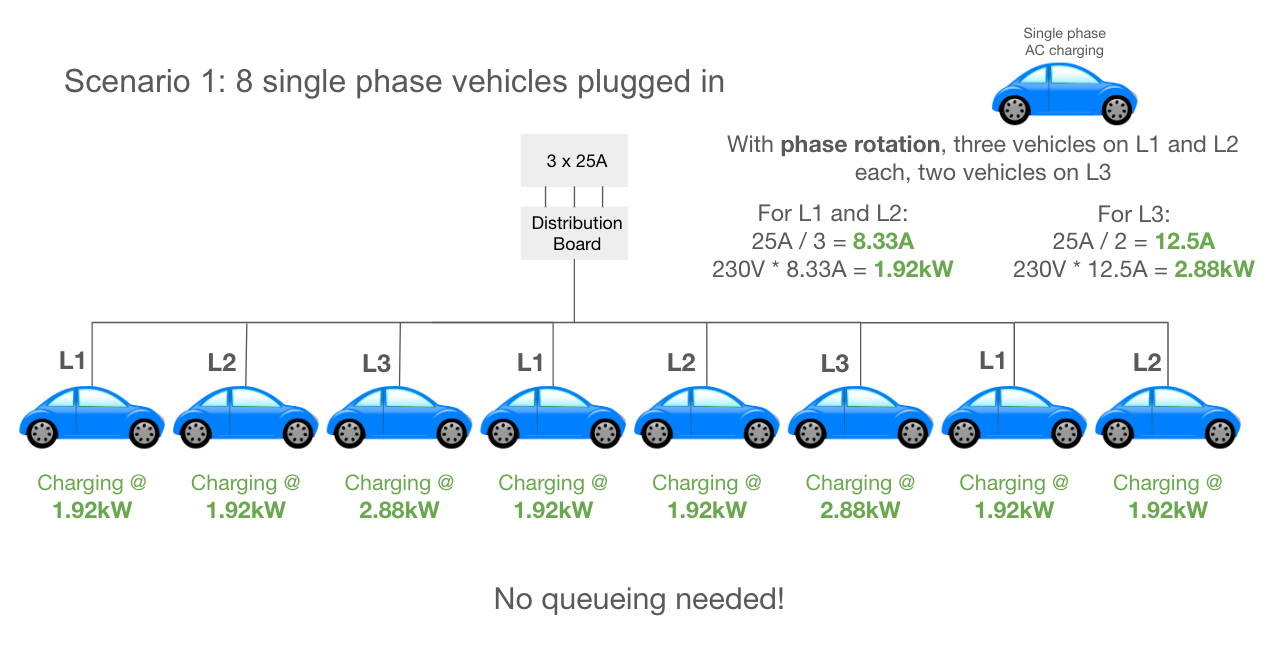
There is a three phase property with a main supply of 25A. They want to install 8 NexBlue Edge charge points. What would be the best way of configuring the charge points to maximise the number of vehicles able to charge, and how fast would each vehicle charge at?
Firstly, the Location would be set to be three phase with a main fuse size of 25A. If a NexBlue Zen has been fitted then this would be clamped over the incoming supply cables. for the purposes of the example, we are going to assume negligable loads in the rest of the property, so the EV charge points have 25A on each phase to use.
In each of the below scenarios, all charge points have been phase rotated, with L1 being used in the L1 terminal for the first charge point, L2 in the L1 terminal for the second charge point, and so on. This only impacts scenarios where vehicles are only able to charge single phase AC, as is the case in scenario 1
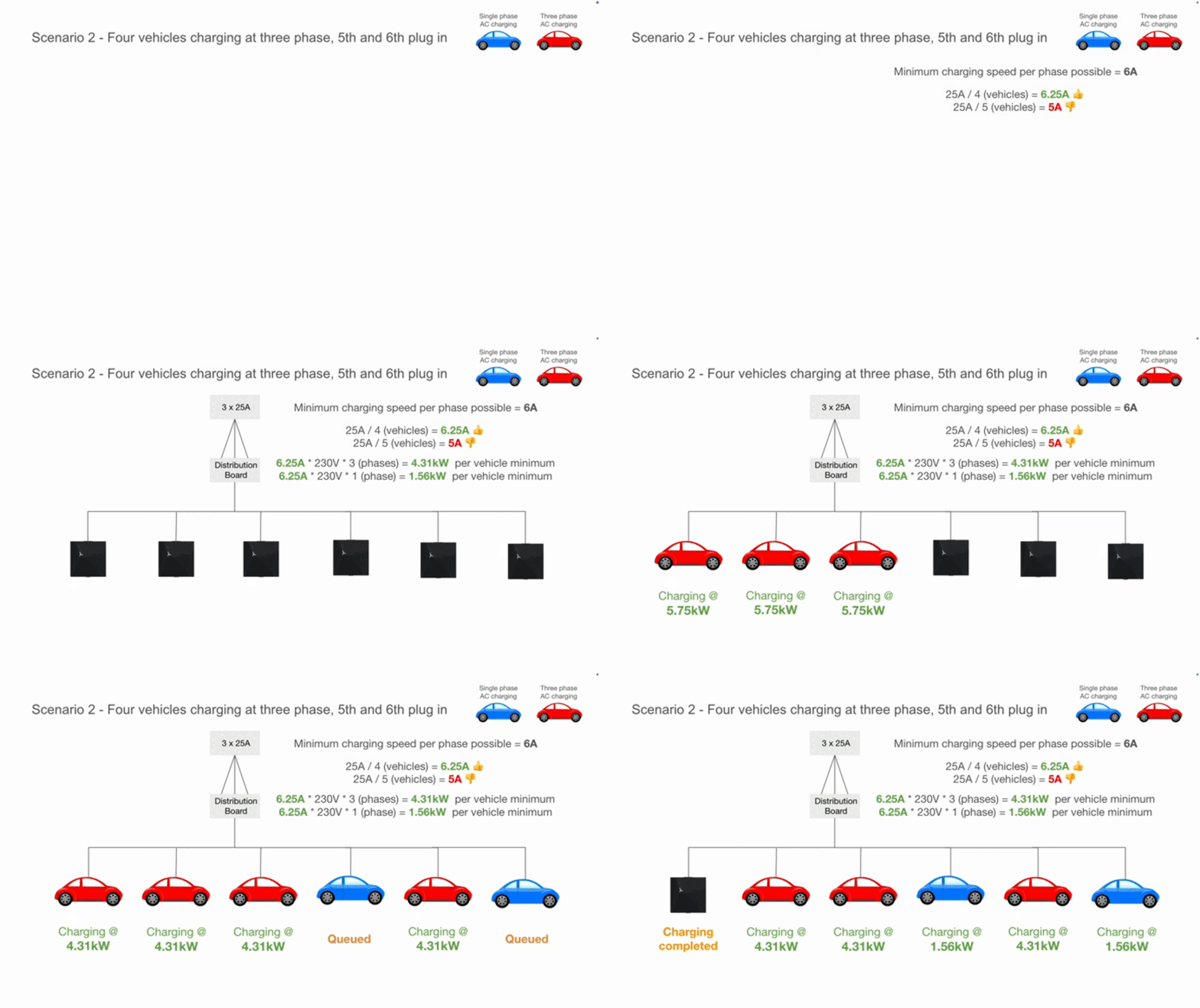
In scenario 2 things get a bit more complicated. As all the vehicles plugged in are utilising the phase phase power, were another vehicle to plug in (single or three phase) they would queue. Once one of the four cars successfully charging have finished, the queuing cars would then both commence a charge. This is because 6.25A has become available on all three phases, and as the units have been phase rotated, they can both utilise two of the additional three phases.